Making Your Software Play Nice Together
A No-Nonsense Guide to API Integration: What It Is, What It Costs, and Who Should Build Yours
Updated June 2026
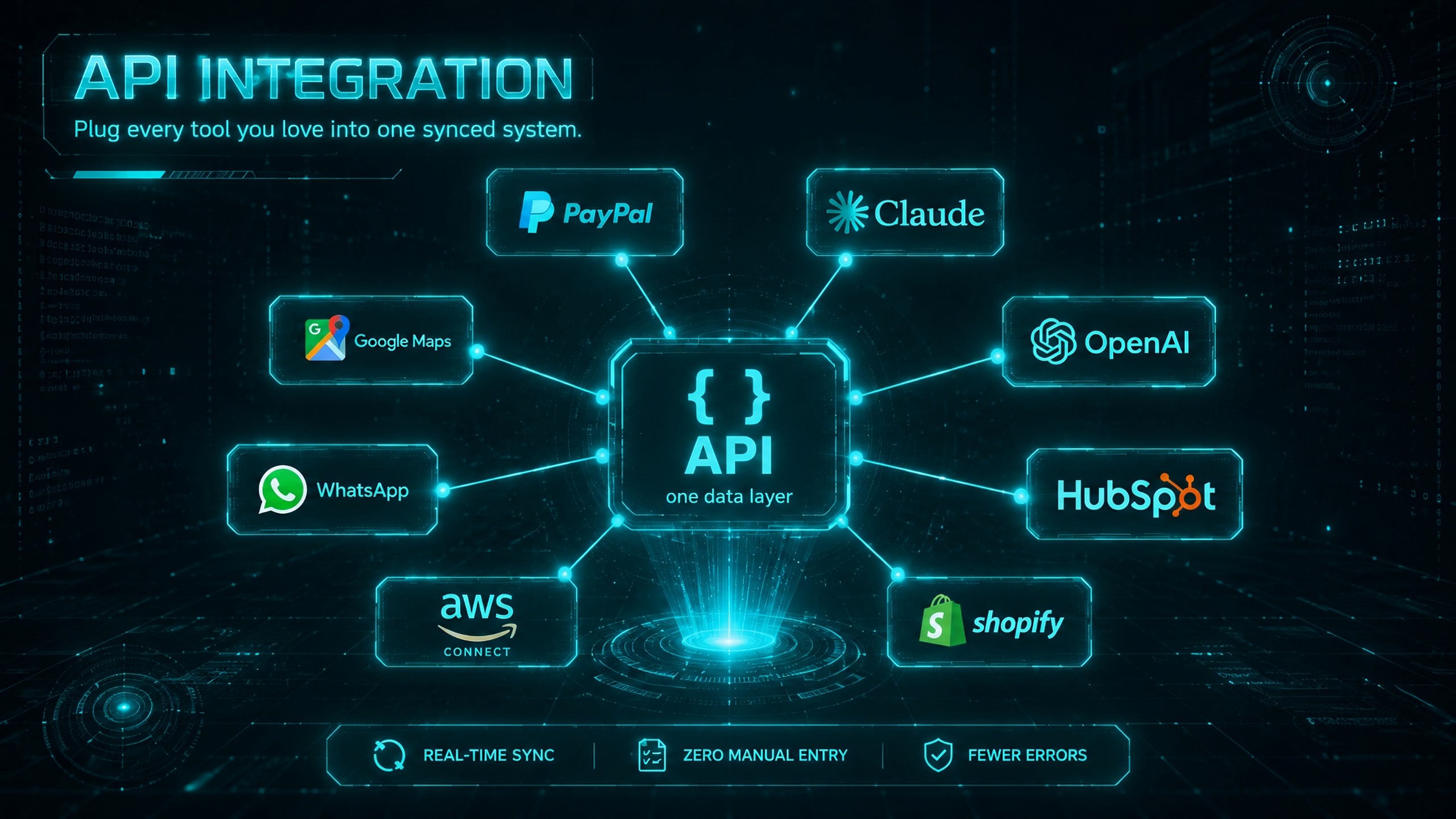
⚡ Quick Answer API integration is the process of connecting two or more software systems through Application Programming Interfaces (APIs) so they can exchange data and trigger actions automatically. Common types include point-to-point, hub-and-spoke, iPaaS, API gateways, and event-driven integration. Businesses use API integration services to connect CRMs, payment gateways, contact centers, POS systems, and AI tools without manual data entry. Costs range from a few hundred dollars for simple connections to $10,000+ for custom enterprise integrations. |
What Is API Integration?
An API (Application Programming Interface) is a set of rules that lets two software systems talk to each other; sending data, triggering actions, and staying in sync without a human copying information between screens. API integration is the practice of connecting those systems together so they work as one.
In plain terms: if your CRM, your accounting software, your website, and your support inbox can’t see each other’s data, your team is the integration, manually re-typing the same customer details into four different tools. API integration removes that manual layer entirely.
Common Real-World Examples
An online store’s checkout page talking to a payment processor like Stripe to approve a transaction in real time
A booking system automatically updating a hotel’s POS and inventory the moment a reservation is made
A support ticket created in a help desk tool automatically appearing in a CRM and triggering a Slack alert
A mobile app pulling live shipping rates from a carrier’s API before checkout
A contact center routing a call based on real-time data pulled from a customer’s account
Types of API Integration Services
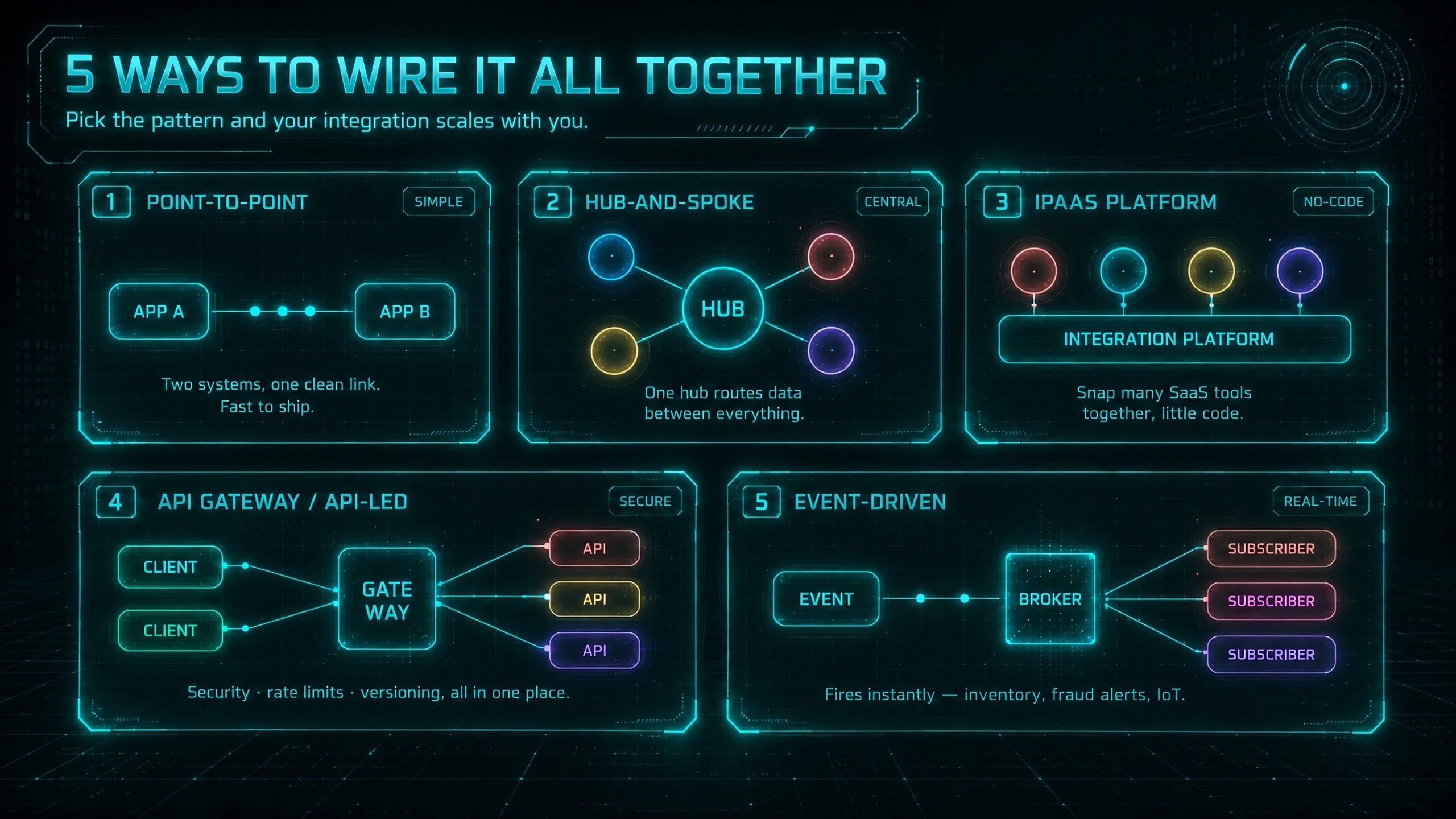
Most API integration falls into one of five architectural patterns. Knowing which one fits your business helps you evaluate any provider or platform you’re considering.
| Type | Best For |
| Point-to-Point | Two systems, simple data exchange. Fast to set up, but doesn’t scale well past a handful of connections. |
| Hub-and-Spoke | A central hub routes data between several systems. Useful for legacy or monolithic environments. |
| iPaaS (Integration Platform as a Service) | Mid-sized teams connecting many SaaS tools without heavy custom code (e.g. Zapier, Workato). |
| API Gateway / API-Led | Enterprises managing many APIs centrally with security, rate limiting, and version control. |
| Event-Driven Integration | Real-time systems that react instantly to triggers — e.g. inventory updates, fraud alerts, IoT data. |
Why Businesses Invest in API Integration
Eliminate manual data entry —information moves automatically between systems instead of being re-typed.
Reduce errors — removing the human middle step removes the most common source of data mismatches.
Real-time visibility — leadership and teams see live data instead of yesterday’s spreadsheet export.
Faster time-to-market — connect to existing services (payments, maps, messaging) instead of building them from scratch.
Scalability — new tools and services can be added without an architectural overhaul.
Better customer experience — personalized, responsive digital interactions powered by synced, real-time data.
📊 Market Context The API integration services market is projected to grow from roughly $5.5 billion in 2026 to nearly $7.7 billion by 2032, driven largely by businesses automating workflows and adopting AI-driven systems that depend on clean, real-time data pipelines. |
What’s Usually Included in an API Integration Service
Whether you hire a freelancer, an agency, or use a platform, a proper API integration engagement typically covers the following areas — and the specific tools that tend to show up in each one:
1. Contact Center & Communication APIs
Cloud contact center platforms (e.g. AWS Connect / Amazon Connect) integrated with CRMs and ticketing tools
AI-powered call routing and intent recognition
Voice, chat, and video channel integration
Real-world example: an interpreter and telephony platform (Ad Astra Connect) built on Amazon Connect for agent call handling, with a speech-to-speech WebSocket integration for real-time AI interpretation, plus Google Maps/Places for location-based routing and Expo/EAS for the companion mobile app
2. AI & Workflow Automation APIs
Connecting AI models to CRMs, inboxes, and dashboards for lead scoring, email automation, and reporting
AI agents that read, write, and act on data across multiple connected systems
Tools that commonly show up here: Anthropic Claude and OpenAI GPT models for content generation and lead scoring, Google Gemini for meeting notes, Groq Whisper for speech-to-text, Langfuse for AI observability, and LiteLLM as a unified gateway when a product needs to swap between models
Real-world example: an AI-powered CRM and proposal platform (BusmanAI) connecting Claude, OpenAI, Serper.dev for lead discovery, HubSpot, Gmail/Outlook APIs, and OneSignal — all feeding into one lead-scoring and proposal pipeline
3. E-Commerce & POS Integration
Payment gateway APIs (Stripe, PayPal, local processors)
POS-to-inventory and POS-to-accounting sync
Shipping, carrier, and fulfillment APIs
Real-world example: migrating a mid-sized e-commerce retailer from WooCommerce to Shopify, syncing products, variants, and store data via the Shopify Admin API and WooCommerce API without losing historical order data
4. CRM & ERP Integration
Syncing customer records between marketing, sales, and support tools
Connecting ERP systems (SAP, NetSuite, Odoo) to web and mobile front ends
Real-world example: an internal HR platform syncing biometric attendance (ZKTeco), AI resume parsing, and SMS/WhatsApp alerts across HR and payroll workflows
5. Mobile App APIs
Social login and social sharing APIs (Google OAuth, Apple Sign In)
In-app purchase APIs (Apple Pay, Google Pay, Stripe)
Push notifications, crash analytics, and mapping APIs
Real-world example: a fintech wallet app using Expo/EAS for builds and OTA updates, with WhatsApp deep links handling support and confirmation flows instead of a separate ticketing system
6. Custom API Development
Building a REST or GraphQL API from scratch for a proprietary product
Authentication (OAuth 2.0), rate limiting, and API documentation (Swagger/OpenAPI)
Real-world example: a property and home-services platform with a custom NestJS API, NextAuth.js plus Google OAuth and Apple Sign In for authentication, PDF generation via @react-pdf/renderer, and Excel exports via ExcelJS
How Much Do API Integration Services Cost?
Pricing depends heavily on complexity, the number of systems involved, and whether you need a one-time integration or ongoing management.
| Scope | Typical Range |
| Simple, single integration (e.g. payment gateway) | $500 – $3,000 |
| Mid-complexity (CRM + marketing tool sync) | $3,000 – $10,000 |
| Custom API build with authentication & docs | $10,000+ |
| Enterprise integration (contact center, ERP, multi-system) | Custom quote, often $20,000+ |
| iPaaS subscription (self-serve platforms) | $20/month – several thousand/month |
Self-serve platforms like Zapier or Workato are cheaper for simple, low-stakes automations but require someone on your team to build and maintain them. Custom-built integrations from a development partner cost more upfront but tend to be more reliable, secure, and tailored to your exact workflow — especially for anything customer-facing or revenue-critical.
How to Choose an API Integration Provider
Selecting an integration partner is a more strategic decision than typical software outsourcing — a poorly architected integration is expensive to unwind later. Here’s what to evaluate:
Technical breadth — Can they work across REST, GraphQL, SOAP, webhooks, and event-driven systems, or are they locked into one approach?
Security track record — Do they follow OAuth 2.0, encrypt data in transit and at rest, and hold relevant compliance certifications (SOC2, HIPAA, GDPR)?
Proven delivery — Ask for case studies or references in your industry, not just a feature list.
Post-launch support — APIs need monitoring, versioning, and maintenance — does the provider offer this, or do they disappear after launch?
Technology-agnostic approach — A good partner integrates whatever stack you already have, rather than forcing you onto a specific platform.
A Provider Worth Considering: Markytech
If you’re looking for a hands-on development partner rather than a self-serve platform, Markytech is a digital product and AI company with 8+ years of experience delivering exactly the kind of integrations covered above, for clients across the US, UK, Singapore, and Pakistan.
What sets Markytech apart from a typical agency is breadth: across recent projects, the team has shipped integrations spanning 12 categories.
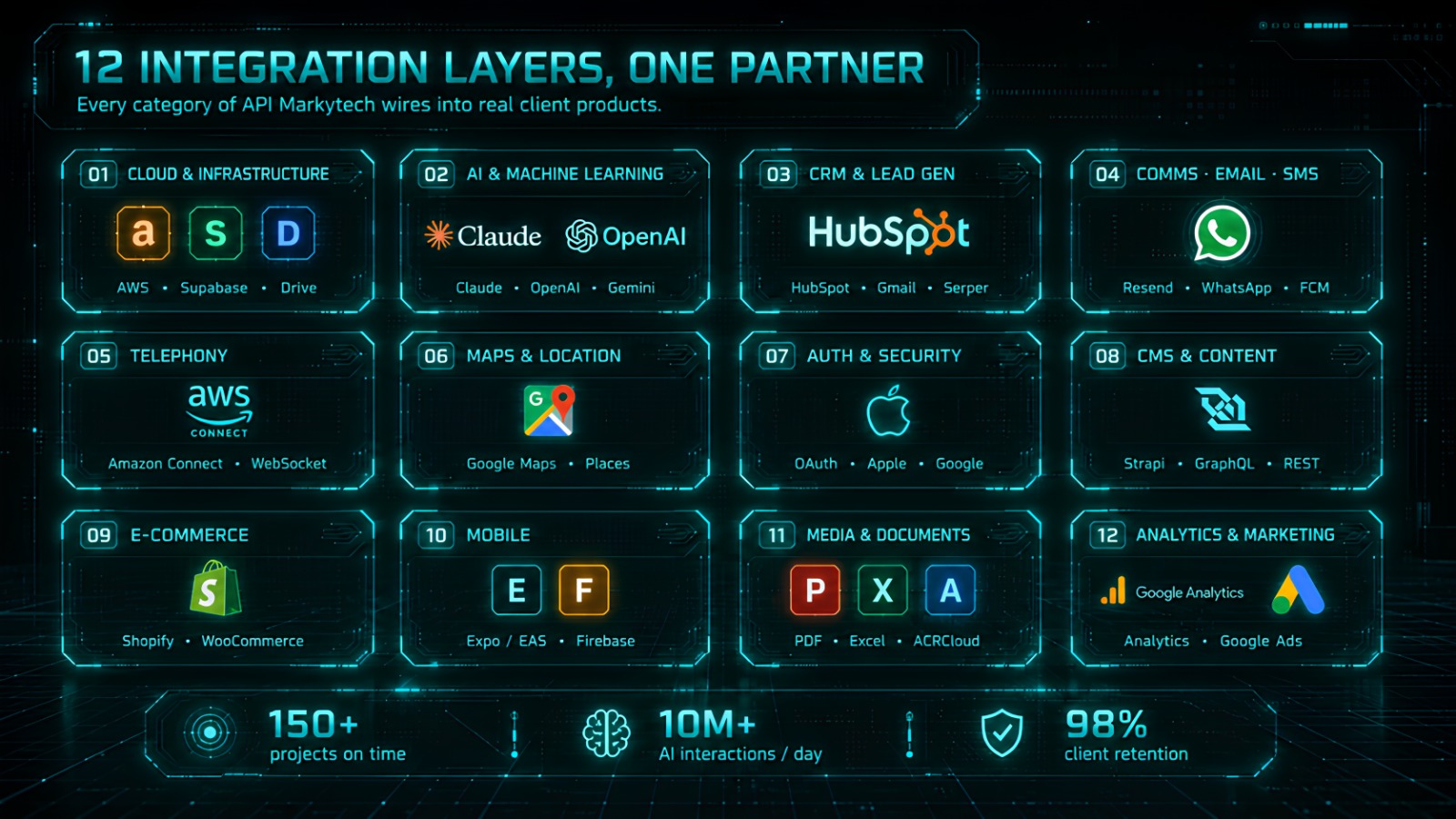
Cloud & infrastructure: AWS S3, SQS, DynamoDB, ECS/ECR/CloudWatch, Supabase, Google Drive API
AI & machine learning: Anthropic Claude, OpenAI GPT, Google Gemini, Groq Whisper, Langfuse, LiteLLM, self-hosted LLM fallbacks
CRM & lead generation: HubSpot, Serper.dev, Gmail API, Microsoft Graph/Outlook, OneSignal
Communication & notifications: Resend, SMTP/Nodemailer, Firebase Cloud Messaging, WhatsApp (WAHA API and deep links), regional SMS gateways
Telephony: Amazon Connect, speech-to-speech WebSocket interpretation
Maps & location: Google Maps Platform, Places Autocomplete, Geocoding
Authentication & security: JWT, Laravel Sanctum/Passport/Fortify 2FA, NextAuth.js, Google OAuth, Apple Sign In, Supabase Auth
CMS & content: Strapi headless CMS, GraphQL/REST content delivery
E-commerce: Shopify Admin API, WooCommerce API
Mobile: Expo/EAS, Firebase FCM, custom backend APIs
Media & documents: ACRCloud audio fingerprinting, @react-pdf/renderer, ExcelJS
Analytics & marketing: Google Analytics, Google Ads conversion tracking
Where Markytech Fits Best
| Area | Detail |
| AWS Connect contact center integration | Cloud contact center builds with AI-powered call routing, integrated with CRMs and ticketing tools |
| AI workflow automation | Connecting AI agents to CRMs, inboxes, and dashboards; internal products include BusmanAI, MeetBot, and AgentMonitor for AI observability |
| POS and hospitality systems | Custom management portals integrated with POS and booking systems |
| Mobile and web API development | Payment gateways, social logins, CRM sync, and custom REST/GraphQL APIs |
| Security | End-to-end encrypted pipelines with OAuth 2.0 authentication |
Worth Knowing: Markytech offers a free 30-minute consultation to scope an integration project before you commit to anything.
Frequently Asked Questions
Q: What is API integration in simple terms?
A: API integration connects two or more software systems so they can automatically share data and trigger actions, eliminating the need to manually transfer information between tools.
Q: What are the main types of API integration?
A: The five main types are point-to-point, hub-and-spoke, iPaaS (Integration Platform as a Service), API gateway/API-led integration, and event-driven integration.
Q: How much does API integration cost?
A: Simple integrations like a single payment gateway typically cost $500–$3,000. Mid-complexity projects connecting multiple systems run $3,000–$10,000. Custom enterprise integrations often exceed $10,000–$20,000+.
Q: Should I use a no-code platform or hire a developer for API integration?
A: No-code platforms (Zapier, Workato) work well for simple, low-stakes automations and small teams. For customer-facing, revenue-critical, or complex integrations, such as contact centers, POS systems, or custom APIs, a development partner typically delivers more reliable and secure results.
Q: What should I look for in an API integration provider?
A: Look for technical breadth across REST/GraphQL/SOAP/event-driven systems, a strong security and compliance track record (SOC2, OAuth 2.0), proven case studies, and ongoing post-launch support rather than a one-time handoff.
Q: What is the difference between an API and an integration platform (iPaaS)?
A: An API is the interface that allows one system to talk to another. An integration platform (iPaaS) is a tool that manages many API connections at once, often through a visual interface, without requiring custom code for every connection.
Q: Can API integrations work with legacy or on-premise systems?
A: Yes. Most modern integration approaches support hybrid environments, connecting on-premise or legacy systems to cloud and SaaS platforms using secure connectors, proxies, or custom adapters.
Q: Does Markytech offer API integration services?
A: Yes. Markytech provides API integration across AWS Connect contact centers, AI workflow automation, POS systems, CRM/ERP platforms, payment gateways, and custom mobile and web APIs — drawing on real deployments across cloud infrastructure, AI/ML, telephony, e-commerce, and authentication systems.
Q: What AI tools does Markytech integrate with?
A: Markytech has integrated Anthropic Claude, OpenAI GPT models, Google Gemini, and Groq Whisper into client products for tasks like proposal generation, lead scoring, meeting note-taking, and speech-to-text, alongside observability tooling like Langfuse and a unified LLM gateway (LiteLLM) for products that need to switch between models.
Need an integration built? markytech.com offers a free 30-minute consultation.